
2027 Compliance Changes: What Every Amazon Seller Needs to Know | Interview with Brian Yam from Blue Ocean Regulatory
Are you prepared for the regulatory and compliance changes coming in 2027?In this interview, the GetReviews team sits down with Brian Yam, Chief Consultant at B..
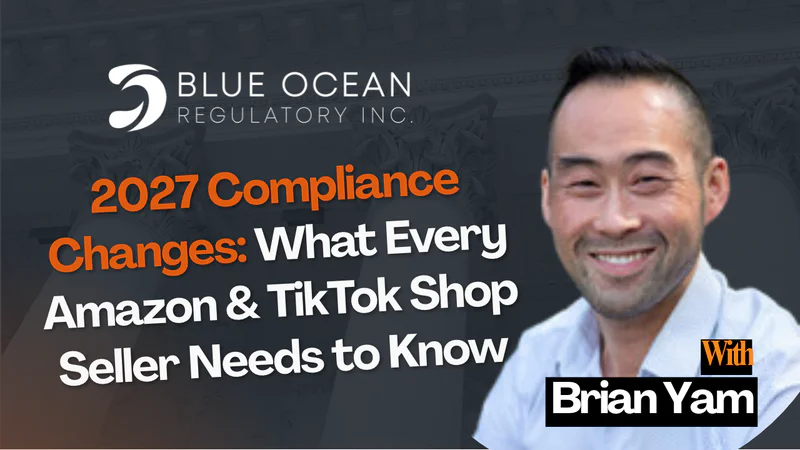
Are you prepared for the regulatory and compliance changes coming in 2027?
In this interview, the GetReviews team sits down with Brian Yam, Chief Consultant at Blue Ocean Regulatory, to discuss the evolving regulatory landscape and what e-commerce sellers need to know to stay compliant and protect their businesses.
From Amazon compliance requirements to FDA regulations for supplements, food, and health-related products, Brian shares his insights on the biggest challenges sellers faced in 2026 and the changes they should prepare for in 2027.
🔗 Learn more about Blue Ocean Regulatory: https://blueoceanregulatory.com/
🔗 Connect with Brian Yam: https://www.linkedin.com/in/brianyam/
🔗 Learn more about GetReviews.ai: https://getreviews.ai
Transcript
(0:00 - 1:22)
Hi everyone, this is Joy from the GetReviews team. I'm especially excited about today's conversation because I'm joined by a fellow Canadian, Brian Yan from Blue Ocean Regulatory. Brian brings valuable expertise in the regulatory space, helping businesses navigate the very complex world of product compliance and regulations.
And you know, with the end of the year, there's really never been a better time to dive into the subject. So I'm really looking forward to picking Brian's brains, hearing his insights, and discussing what sellers really need to know to stay compliant and ahead of the curve. So Brian, thank you so much for joining me.
Thanks for having me. Awesome. And you know, before we go into some of the questions that I have prepared for you, is there anything you want to kind of say to our audience or maybe just a brief short introduction about yourself? Yeah, for sure.
Gosh, been in the supplements, natural health product space since 2004. I was brought in to a particular company that was making these natural health products, vitamins and minerals because of Health Canada's new regulations at the time. So about the NPNs and testing and all of these things, that was really where I started my career and then just kind of climbed the corporate ladder, moved there, moved into the consulting world, worked for the brand side as well as manufacturing.
(1:23 - 3:58)
And now we serve a vast majority of clients in the US and Canada. So North America, we serve them to help them out with the whole FDA Health Canada compliance for their supplements and natural health products. So yeah, that's that's the quick background.
But happy to be here. Awesome. Thank you so much, Brian.
And, you know, if we were to get straight into the questions right away, you know, it's November right now, we're heading towards the end of the year. So I think it's always just a good time to reflect on what's happened so far in this year. I'm curious when it comes to, you know, some of the biggest regulatory changes and compliance trends you noticed this year.
Would there be any ones that you've noticed or some of the biggest ones that you've, I guess, trends that you've noticed for this year? I guess there's a couple. I think the big one is the increased amount of verification. It's like a fancy word of saying these platforms, Amazons of the world, they're putting their checks in place to check on the brands if they're in compliance.
So that's that's increased. I know Amazon, at least in the US side, has really changed things a lot more. They've released rules, I think, a couple of years ago, but then since built on them, at first, they were doing testing on certain categories of products.
Now they've opened that testing up to all categories of products now. So it's just the nature of the game. A lot of these distributors, these distribution channels, these platforms, you know, the regulatory authorities want to go after them because they make the impact, right? They set the stage, they set the rules for the rest of the industry, at least that's the thinking.
So that's where you're seeing that level of verification increase. It's only going to increase. I'm sure some people are like, dang it, why? But that's just the nature of the game.
And they do that not only to add a level of compliance checks for the sake of the customer, but also to protect themselves too, right? They don't want to be selling any products that are shady, that could put their company at risk either. They've been served with lawsuits or, you know, similar action, and FDA warning letters and that type of action. So they want to avoid that.
So they're putting a lot of these checks in place. And the other one that I think that is, it's not really a regulatory trend, but I'm seeing this more from a business standpoint. And it's all tied to the cost of everything is increasing, right? We all know we're seeing this in our grocery, you know, every time we go to the grocery store, etc, and everything we're doing.
(3:59 - 6:30)
And I think we're seeing that also at the manufacturing level, our cost of goods are increasing, the raw material prices are going up, you know, and as a result, brands are trying to figure out, how do I save money? How do I bring that cost of goods down? And that means for some, and we're seeing this trend kind of increase a little bit more is importation, where can I get this made somewhere else for cheaper, and then bring it into the country, bring it to the US or Canada. And then that has its own set of rules and regulations that a lot of brands aren't aware of, thinking that it's just a matter of shipping it over the border, and you know, call it a day. It's not the case, there's a lot more involved, we don't have to go through all of those things today, or any of those things today.
But it's just another trend that we've been seeing over the year as well. Yeah, absolutely. And I think you make a really good point in some of the trends and changes, biggest changes for this year.
By any chance, did you get a chance to attend Amazon Accelerate this year? No, I haven't had the chance. It's been insane. Yeah, this year has been very, very busy, which is good busy.
But yeah, I wish I was able to attend some of these other events. But yeah, what what do they talk about there? Yeah, I mean, well, it was my first time attending. And one of the workshops I attended, or speaker sessions I attended was on risk and compliance.
And, you know, I know the Amazon team, they really did kind of dive deep into what triggers this risk and compliance, you know, as to why your account might need more verification, right? So when it comes to your products, or maybe your, maybe any additional papers that needs to be uploaded regarding your products. But, you know, one of things that actually really surprised me was at the end of the speaker session, you know, there was maybe like, five to 10 minutes left. And they asked if any, you know, one in the audience had any questions.
And I was very shocked to see as to how many people raised their hands up. And they were really expressing a lot of anger and frustration. Yeah, it was a lot of, you know, my product received this, you know, compliance or regulatory, you know, I got this notification, I'm uploading all of the necessary papers that you need, they might not be in the supplements space, they might be specifically in any, it seemed actually, there were a wide variety of different sellers from supplements to, I think, like electronic goods to just like home appliances.
(6:31 - 9:43)
You know, it seemed, I was very shocked to see as to how many people were frustrated, and how a lot of them didn't get a clear answer. But I'm assuming that this is going to be a continuous trend that we're also going to be seeing probably in 2027. And just in like the future years as well, just because, you know, Amazon wants to make sure that they're on top of their stuff as well.
Yeah, 100%. Yeah, I can see the frustration. I think Amazon hasn't done a great job of explaining exactly like the more ground level or tactical level of what the requirements really are.
I think there's an assumption built in I think, me free speaking freely. I think there's a lot of people that are in this space, helping Amazon build their compliance program that are like myself, they're in compliance, they know the world, they know the lingo, they know the documentation. And I think they just assumed that all the sellers would know that.
And as a result, there could be some confusion, right? And frustration out of that. So yeah, but you're right. I think there's going to be a definitely an increased trend and documents and test results and testing and all that fun stuff.
Yeah, absolutely. And in terms of, you know, for the sellers that you've worked with over the, you know, last year, did you notice any common mistakes that they made? And, you know, what they can maybe do to and for maybe any new sellers, what they can do to mitigate those mistakes for the next year, or just anything that they should be really prepared for when it comes to compliance and regulatory? Yeah, the big one that I see over and over again, is we have to operate under the assumption that your product is going to fail testing. It's like a it's a mind shift.
So a lot of the times we're thinking, let's just roll the dice and see what happens. If it passes, it passes, and you're good to go. But we have to think of with and we have to build the business from the point of view, what if it failed? And then so if it failed, how do you prevent that? And you have to kind of work backwards, backwards from there.
So what that means is, working upstream really early in the process, is my formula compliant? Are the ingredients compliant? How can I prove that? Then when you work with a contract manufacturer, the assumption is they're going to take care of a lot of the compliance for you. They're obviously NSF certified, they're JMP compliant with Health Canada. So of course, they're going to do the right things.
But if we leave it to them, a lot of these manufacturers, they have default processes. The default mindset of the manufacturers, how do I get a product to pass testing after I produced it? Once it's passed, it's not my problem anymore. And so they'll do the minimum to get to that point.
Whereas the seller is thinking about, what happens if I take that inventory three months later, Amazon tested or TikTok wants documentation, and there's a failure out of that. Now, how do I fix that? And a lot of the times, the manufacturers said, you didn't tell me this, you didn't bring anything of this up. We did what our end of the bargain, which was, we tested the finished product at release and everything passed.
(9:43 - 11:14)
So when you work backwards, you realize, you have to put a lot more checks in place upstream, from R&D, to onboarding with the manufacturer, double checking their work. And it's, again, it's new, it's a lot more work and a lot more hands on and probably a lot more than the typical new brand is expecting. But the goal really, at the end of the day, is like, how do we build in those checks to prevent that failure from happening in the first place? And then what if it did happen? What if it was a legitimate failure? How would that manufacturer react and support you? And it's hard because a lot of times when you're talking to a sales rep, the manufacturer, they're going to tell you everything's fine.
We do this for all the brands, they give you all the reasons why you want to work with them. And then something actually bad happens like, oh, go talk to QA, they kind of just push you along there and you never hear from them. So there's a lot more work that needs to be done upstream and fleshing all of this out so that it minimizes that issue from ever happening in the first place.
So I think that's like the big mind shift. So you're investing a lot more time to prevent those issues versus spending the money after and maybe getting new inventory or throwing out old inventory that failed and doing more tests to figure out are these test results legit or not. So yeah, I think that's the biggest one for me in terms of what can we do to kind of fix these issues from happening in the first place.
(11:14 - 11:33)
Yeah. So it seems like you really need to take preventative measures rather than having the situation play out and then finding solutions to it afterwards. But it's just always better to be more preventative, making sure that everything is in place before you actually start going time.
(11:34 - 12:09)
Yeah, because with supplements, you can't let it if you let it play out. What are your options? Really? Everything's already locked in your raw materials are already encapsulated. You've already used up the labels or in a finished bottle.
It's really hard for you to take that all apart and fix that, right? A lot of times you're discarding it, you might be able to rework some of that. But yeah, I can get pretty involved. And what you're trying to do is just because you can't fix it downstream, you got to really make sure all the checks are done properly.
(12:09 - 16:20)
It's just a mind shift. Yeah, absolutely. And I'm just curious, do you notice that you made a really good point of how the cost of goods have been increasing significantly? And, you know, I would say in the e-commerce industry in the last year or two, especially, you know, with tariffs and things like that, we've seen I personally have seen some sellers from get reviews.
I'm sorry, sellers that work with get reviews. You know, I'll have some calls with them. Everything is going really well.
They're excited about using get reviews for their services, but or implementing it into their business. But, you know, maybe a few months later, I'll hear back from them saying, you know, we decide to no longer continue our business. You know, it's just not feasible for anymore.
It's not feasible for us anymore. It's just not the right business decision for us to do right now. I'm curious from, you know, as you're also working directly with these sellers, do you hear a lot of, you know, comments or, you know, comment comments or, you know, a lot of these sellers also sharing their fears of continuously running their business just because prices have increased, you know.
Yeah. It's not feasible or it's just not the right thing to continue running their business. Have you seen any cases like that over the last year? Oh, absolutely.
I mean, since the whole like the U.S. Canada tariff situation or tariff war. Absolutely. That made a huge headline, I think, especially last year, if I remember correctly, I believe was last year when it was all the discussion and a lot of brands were switching to Canadian made product if they were a Canadian company and then U.S. were switching to U.S. product and they were trying to minimize the level of importation and all of that.
Absolutely. Even this year, we've seen some fall out of the lack of a particular trade deal. So some brands, they've been exporting product across the border.
And now that ability to do that has really been minimized. Right. The amount of tariffs and just the sentiment from the countries have really reduced their ability to to sell or market their product and the sales just aren't there.
So as a result, they're telling us that and, you know, they're cutting back on their hours and their spend on either advertising or compliance activities, et cetera. So I definitely feel that effect. And I think the big takeaway here is to you do want someone to watch out and see what the political environment is looking like to see how does that impact your brand? I think a lot of sellers, I think for the smaller brands, let's say they're just focused on the sales, they're just focused on, you know, making getting the business to grow from that point of view of just typical marketing and sales.
But I think there's an element of understanding what are these new regulations coming in? What is the political landscape look like and how could that impact each business? And right now, it's like anything cross borders. It's tougher for sure. Absolutely.
Definitely a sensitive, definitely something that's very, very sensitive right now, I think, especially within Canada. And I noticed that a lot of Canadian sellers are more hesitant in selling in the U.S., for example. And I think also vice versa.
I think, you know, U.S. brands are less hesitant to also sell in Canada as well. But it's really interesting that you're noticing those trends as well. And, you know, from a seller from, you know, the perspective of us also working directly with, you know, sellers of all different sizes, especially like the smaller size ones, they just realized, oh man, doing running an Amazon business is just not right for me anymore.
I get it. I get it. It's unfortunate, but hopefully things will work out in time.
Yeah, absolutely. And, you know, I would say it is my understanding that you don't just work with. I know primarily the sellers, you probably work with their biggest marketplaces that they're selling on is, for example, Amazon.
(16:20 - 17:54)
But I'm curious from your perspective, have you seen any recent trends or changes in sellers and what kind of marketplaces that they're interested in maybe entering? You know, I would say Amazon definitely has its pros and cons, just like any marketplace, actually. But the reason why I asked this is because, you know, I attended the Prosper Show, you know, which is a conference that's specifically focused and catered over the last few years just for Amazon sellers. But I was really surprised to see as to Walmart being one of the biggest sponsors there.
And TikTok also had a booth there. And Coupang, which is Korea's equivalent to, you know, Amazon was also there as well. And they were trying to encourage sellers to actually start selling in these different markets.
I'm curious on your end, over the last year, have you seen more and more sellers wanting to expand or enter into different marketplaces? Yeah, absolutely. So we do work with brands outside of Amazon, either they're selling DTC, or through the traditional brick and mortar channels, or other online platforms. Very, very normal.
And I think the big thing that we are seeing is that shift away from typical or traditional brick and mortar and into these online channels. Amazon, though, is feeling a little bit more well established, right? So it's a lot more competitive to get in, there's a lot more competitive to stand out. It takes a lot more money and advertising to get noticed on that platform.
(17:54 - 20:32)
So they are looking at other channels as a result. So yeah, definitely, definitely see that. I'm not surprised.
But, you know, at the same time, I think it's easy for us to assume, if it's a fresh channel, let's take advantage of that, because there's probably less compliance. And maybe you could win in the short term. My argument is like, you want to win in both the short term and the long term.
And so you want to be able to navigate both scenarios, right? And so that's why factoring in the compliance, working upstream, and all of those other things we talked about is so important. And even though a channel might not have requirements today, likely they'll have it tomorrow. So that's something to factor in.
But yeah, definitely seeing that overall trend of just switching away from that traditional brick and mortar channel. Yeah. Have there been any marketplaces that you're seeing that is gaining a lot of interest from your sellers? I think it's still Amazon.
I think we're seeing a lot more TikTok interest as well. But it seems that it's getting harder to get into TikTok lately, for some of the brands we work with. So that's been the thing.
But I think everyone's just trying to get into those two big channels. Otherwise, it's going to be a D to C play. And how do they get more eyeballs to their own website and all that fun stuff? Yeah, absolutely.
And I'm curious as to, more and more brands are now expanding into entering different marketplaces, with each having their own, for example, compliance rules, maybe different challenges. I know you mentioned a really great tip on how brands should be preventative and take preventative measures. But as brands are more entering into different marketplaces, is there anything else or kind of maybe tips that you want to share to these marketplaces that are making further moves in their business and just continuously expanding into other marketplaces? Yeah.
So I think the big one here is, we don't want to assume that just testing and a label, like having a compliant label and testing the product is going to be sufficient. We're seeing the trend. It's repeatable, it's predictable, right? All these platforms, if they don't have a compliance program, now they're going to have one later, or they're going contractual agreements in the fine print that you have these types of compliance programs in place.
(20:32 - 21:42)
So something to think about. The other thing is the whole AI conversation. So, you know, a lot of clients, a lot of brands are now using or leveraging AI to help them understand what these requirements are.
And I think if anything, it's brought on more questions than clarity that they were hoping for. So what we've been seeing is AI can do two things. They either, it spits out this huge list, because it's just trying to tell you all the things you need to worry about.
And then it overwhelms the user. Or what happens is it points to one or two things, but those one or two things might not be right for that particular business. And it's really just driven through either however the AI was trained or previous conversations.
But I've seen the conversations take them down the wrong path. So that's the other thing. So it's good that they're using AI.
I think if it can help simplify the requirements, and help them understand why these things are important, and give them a sense of what this means, that's important. That's great. Then I think there's an element of, all right, cool.
(21:42 - 22:27)
You may want to invest in someone that actually understands this world so they can decipher, is this still the right path for you? Are these the activities you want to focus in on? There's too many times where we're getting requests to do XYZ. XYZ is not something they want to spend their money on, in my opinion. It's a waste of their money, a waste of their time.
But that was what they were told to do in their research. And so that's another trend. And it's going to take lead them down this wrong path that's not ultimately going to satisfy what the distribution channel or the platform really wants them to do.
It's just the juice isn't worth the squeeze. But they don't know that. And I think that's the other element here that we're trying to emphasize.
(22:28 - 26:57)
Yeah, you make a really good point. And I kind of want to go back into that. You mentioned the AI aspect of it.
Have you met a lot of potential clients or clients of yours where they're like, Brian, I used to chat GPT and Claude to look into this, and they said that this is okay, but you're telling me something different. Does that happen often? It happens a lot. And I don't get offended by it.
I get why that is the case. And I think they're just looking for that. Like, how do I know what's right? I think that's really what they're trying to solve.
And that's just the reality of the situation. And what I try to do to address that is just explain the logic. Why are we looking at this? What value is that really bringing me? And is that really what you need right now where you are in the launch phase or in the stage of your business? If you're an established brand, you're going to need a lot more compliance programs, SOPs, and recall procedures.
If you're a brand new just launching tomorrow, it doesn't make sense to do all of these things because you're spending money on a problem you don't have yet. But AI doesn't know that, right? And sometimes there's conflicting information. And I think what normally happens out of that is there's an element that AI missed.
And that's you and I, when we're using chat or cloud or whatever, it's missing a variable. And you just didn't ask it the right question. You, the collective you, the general you, you didn't know what question to ask it or what information to provide it.
Whereas someone with a compliance background, they're like, no, but da-da-da-da-da, did you consider this? Oh, yeah, right. Didn't consider it. Therefore, that's usually the case.
So what we do is we address it, we give them the and then they might run it through their AI and then realize, all right, Brian was right. And then they realize too, AI only goes so far, at least as of now, right? Maybe it's going to change. Most likely it's going to change, but they come to that realization of, all right, it's good as a starting point, but in order to execute and to actually prioritize, we need someone with natural intelligence to help with that.
It's just the scenario that we're in. Yeah. You make a very good point because I think, you know, with any of these AI tools, it really all depends on the prompt you give it.
And the question you tend to ask is, or, you know, the general user tends to ask a very, you know, give me kind of advice, right? Just give me general advice. And these AI tools does a good job in giving you the answer that you want to hear. But as soon as you start asking the, but what if this happens, or, you know, but what in this case, if it's this, that is when, you know, they'd say, oh, in this situation, it's a bit different, you know? So you make a very, very good point.
Yeah. It's frustrating, but it's the reality that we're in. Yeah, absolutely.
But, you know, it's always good to have an expert like yourself do all of the, you know, fact checking and, you know, being able to work with these companies and giving them the real information. Yeah. Now, you know, one of the things I always see is that when it's a new year, we tend to see, for example, like a lot more interest of people wanting to start like an Amazon or their own e-commerce business.
You know, usually a lot of people have, for example, like a New Year's resolution of, you know, wanting to start their own business. If you Google, what kind of business should I start? You know, Amazon business tends to be one of the top of them, you know, happens to be on top of them. But, you know, I would love to ask you, you know, if you were advising, for example, like a new supplements brand or a relatively new supplements brand that's just entering the market, you know, what would you say is some feedback or tips or guidance that you can share with them that they should prepare for now to, you know, stay competitive and avoid any disruptions in 2027 or even beyond or, you know, things on that, based on what you see? Yeah, gosh, there's so much.
(26:59 - 29:59)
I think one is if you can become a brand like that does this, if you can try not to be a brand that's dependent on the health or functional claims of the product, or like a quantity of an ingredient, like this is 1000 milligrams of creatine, while mine's 1500 milligrams of creatine, while mine's 1501 milligrams, like you don't want to play that game, you don't want to play this game of claims, my product does boost memory. And the reason why is you're going to get a competitor that's going to outshine you there, they're going to take more risks, they don't know the compliance landscape, they don't care, right? You just never know. And so when you start playing this game of, you know, this thing of who's got the better claim, it's just not going to work out for you, right? So I think there's an element of, well, what kind of, what are you going to make your product for? Like, who are you making it for? What do you guys stand for? What's the brand all about? I think that is the biggest thing, create a brand that isn't dependent on claims or something superficial like that.
I mean, you can still talk about these things. But it's not the reason why you're there. And it's not the real reason why your customers are buying.
So that's like the goal. Like if you can get there, I think that would be a huge relief off the shoulders. Okay.
I think the other one is your, like your ingredient choices, you don't want to lock yourself into any ingredients that are really, really expensive, or that's going to be really expensive. And there are some ingredients right now that we know are in high demand, hard to source, you've got whey protein, they've got like tariffs, actions all over it as well. Whey protein in general is very, very expensive.
So and then usually the larger, larger established brands, they're just buying this stuff up. And they're just locking that market in for themselves, which increases the price for everybody else. So I think there's a supply chain equation that people should be looking at, brands should be looking at not just what's trendy, what's working, right? Because you want to be able to continue to buy the next order and the order after that within a reasonable cost, versus you buy it now, maybe today you got lucky, and then six months later, the price has doubled.
So I think there's that supply chain component. And I think the third one is don't, I've said this many times, don't assume your manufacturer is liable, or responsible for all your compliance. It's just, yes, they are a huge part of that equation.
But you have to remember, there's elements of that relationship that they're not responsible for anything goes on the label, they're going to test their way the cheapest way versus you might use slash Amazon will require a different higher level of testing. And if we don't tell the manufacturer that they're not going to do anything different. shelf life, if you have a two year shelf life, the manufacturers, they don't verify that.
What is GetReviews.ai?
GetReviews.ai is a tool designed for e-commerce sellers on Amazon, Walmart, and more to increase post-purchase customer engagement platform through QR codes, and survey flows and help generate more authentic, compliant product reviews and build stronger relationships with their customers after every sale.
Read how Amazon sellers have found success with Getreviews:
How a European Gadgets Brand Turns Insert Cards Into an Amazon Review Engine
How a Craft Display Manufacturer Turned Amazon Buyers Into a Steady Stream of Reviews
Book a demo today to learn more:
Learn how to get more reviews.
Monthly tips from industry insiders on using customer feedback to increase sales.