
GetReviews.ai at Prosper Show 2026
By: Joy Pak, Director of Growth and Customer Support Prosper Show is always one of the most anticipated events in the Amazon seller ecosystem, and this year it ..

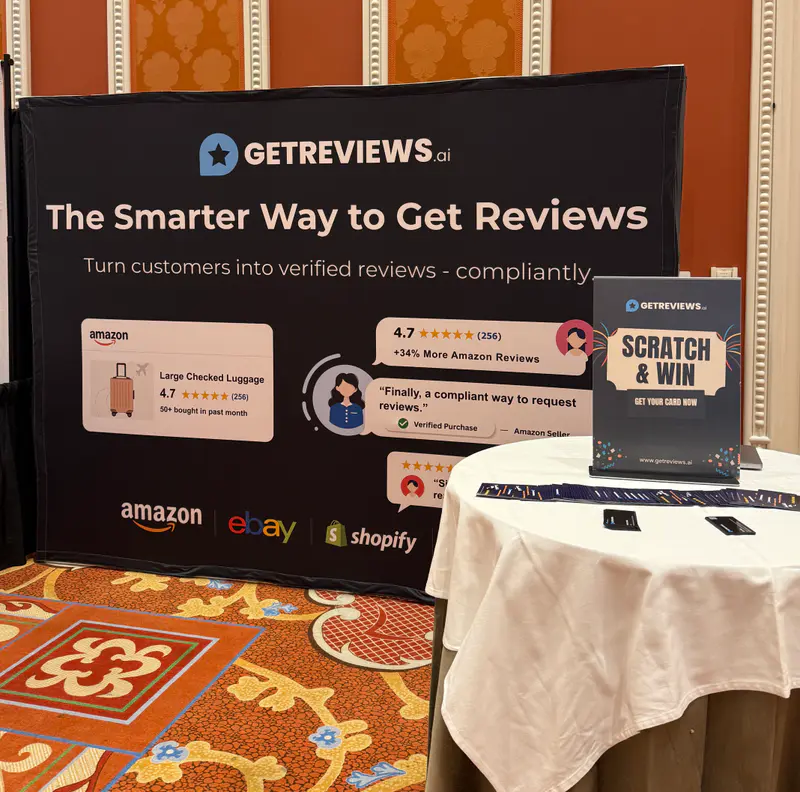
Our First Time Sponsoring the Prosper Show — Here's What We Saw
By: Joy Pak, Director of Growth and Customer Support
Prosper Show is always one of the most anticipated events in the Amazon seller ecosystem, and this year it took place on March 10 to 12, 2026, at The Wynn Las Vegas. It was extra special for us — it was GetReviews's first time sponsoring and exhibiting. This made us pay even closer attention to what sellers were discussing, what was trending, and where the industry was heading. Here's what stood out.
The Women's Meetup

One of the most memorable moments of the entire show had nothing to do with a booth or a keynote. The women's meetup was a genuine standout — and honestly, one of the most energizing parts of the show.
The room was filled with sharp, ambitious sellers, operators, and brand builders. What struck me most wasn't just the talent in the room — it was the sense of community. These were women who had built real businesses, navigated real challenges, and showed up at Prosper not just to learn but to connect and lift each other up.
The e-commerce space has historically skewed heavily male, particularly at events like this, so seeing a dedicated space packed with women who are thriving in the industry was genuinely inspiring. It's a reminder that the seller community is broader and more diverse than the main floor sometimes reflects — and that when you create the right environment, those voices show up loud and ready to engage.

Multi-Marketplace Selling Is the New Normal
One of the most exciting developments was the growing presence of marketplaces beyond Amazon. Walmart had a strong showing, and the one that was genuinely most surprising to me was Coupang — a sign that international platforms are investing heavily in courting US-based sellers.
So why might Walmart be so motivated to bring sellers in? Over 95% of the products available on Walmart.com now come from marketplace sellers, not Walmart's own inventory (source: Teikametrics). The more sellers they attract, the broader their catalog, the more competitive they become against other marketplaces like Amazon, and the more advertising revenue they generate. Amazon still has approximately 1.9 million active sellers compared to Walmart's 200,000 — roughly 9.5 times larger (source: Red Stag Fulfillment) — which means less competition in most categories and more visibility for brands willing to move early.
Coupang is South Korea's equivalent to Amazon, with over 30 million monthly active users, representing over 55% of Korea's population. As someone who has lived in Korea for a few years, I can confidently say that if you are a US seller looking to reach the Korean market, this is the marketplace for you.
The conversations we had confirmed what the data is already telling us: more and more sellers are diversifying where they sell, with Walmart increasingly becoming the go-to second channel. If you're still Amazon-only, the community is nudging you to not to put all your eggs in one basket.
Selling on Multiple Marketplaces Is One Thing — Managing Them Is Another
The shift toward multi-marketplace selling is exciting, but it comes with a layer of operational complexity that doesn't get talked about enough. When you're running storefronts across Amazon, Walmart, Target, and beyond, the data fragmentation alone can be paralyzing. Each platform has its own dashboard, its own metrics, its own reporting cadence — and trying to stitch together a coherent picture of your business from five different tabs is where growth strategies go to die.
This is why analytics consolidation is becoming just as important a conversation as marketplace expansion itself. Knowing that you're selling on more channels is one thing. Actually understanding which channels are profitable, which SKUs are underperforming where, and how your advertising spend is working across platforms — that's the intelligence that drives real decisions.
Tools like MerchantSpring are built exactly for this moment. Designed for brands and agencies managing multi-marketplace operations, MerchantSpring consolidates performance data across marketplaces into a single, unified view — giving sellers the clarity to act rather than just react. Whether you're comparing revenue by channel, tracking listing health across platforms, or reporting to clients across a portfolio of brands, having that consolidated layer isn't a nice-to-have anymore. As the marketplace landscape keeps fragmenting, it's becoming the operational backbone that serious multi-channel sellers can't afford to go without.
The sellers who win the multi-marketplace era won't just be the ones who show up on the most platforms — they'll be the ones who can actually see and understand their entire business at once.
Expanding to New Markets Means Rethinking Shipping
With so many brands eyeing new marketplaces and international expansion, one conversation that kept coming up was logistics. Reaching customers outside the United States isn't just a fulfillment challenge — it's a growth bottleneck if you don't have the right partner in place.
That's where solutions like SkyPostal become essential. Specializing in last-mile delivery across hard-to-reach markets, Skypostal gives sellers the infrastructure to actually follow through on their expansion ambitions without the typical headaches of cross-border shipping. As more brands set their sights beyond domestic channels, having a reliable international shipping partner isn't optional — it's the foundation the whole strategy rests on.
AI Is Everywhere — and It's Actually Useful
If there was one theme that dominated booth exhibitors and conversations this year, it was AI. The number of AI-powered tools and apps on display was hard to ignore, and the quality has clearly leveled up. One standout we came across was Aakaar AI, which caught our attention as a genuinely interesting application in the space.
It goes beyond a typical ad management tool — it's a fully AI-native platform that deploys autonomous agents to handle the day-to-day heavy lifting of Amazon operations, from bid adjustments and budget allocation to campaign analysis. Sellers and account managers can guide strategy using plain natural language instead of wrestling with complex rule-based setups, and every automated decision comes with a clear explanation of what changed and why.
Tariffs? Barely a Whisper
This one surprised me. I attended Ecom North in September 2025 in Toronto, Canada, where tariffs were practically the only thing anyone wanted to talk about. Prosper felt noticeably quieter on the topic. I'm not sure if it's due to Ecom North being attended by more of a Canadian audience. Whether sellers have adapted, accepted the uncertainty, or are simply moving on, the urgency just wasn't there in the same way. It was a telling shift in the room's energy.
Reviews and Package Inserts Are Still King — But Sellers Need a Starting Point
For all the shiny new tools and trends, the fundamentals haven't changed. Reviews and post-purchase engagement remained a top priority in nearly every conversation we had. The challenge isn't awareness — sellers know they need reviews. It's knowing where to start and how to do it compliantly and effectively. That's exactly the gap GetReviews is built to fill, and the conversations we had on the floor only reinforced how real that need is.
What is GetReviews.ai?
GetReviews.ai is a tool designed for e-commerce sellers on Amazon, Walmart, and more to increase post-purchase customer engagement through QR codes and survey flows, and help generate more authentic, compliant product reviews and build stronger relationships with their customers after every sale.
Book a demo today to learn more:
Learn how to get more reviews.
Monthly tips from industry insiders on using customer feedback to increase sales.